Posts

๐‡๐š๐ฉ๐ฉ๐ฒ ๐Ÿ๐Ÿ‘๐Ÿ”๐ญ๐ก ๐๐ข๐ซ๐ญ๐ก๐๐š๐ฒ ๐ญ๐จ ๐Œ๐š๐ญ๐ก๐ž๐ฆ๐š๐ญ๐ข๐œ๐ฌ ๐†๐ž๐ง๐ข๐ฎ๐ฌ ๐’๐ซ๐ข๐ง๐ข๐ฏ๐š๐ฌ๐š ๐‘๐š๐ฆ๐š๐ง๐ฎ๐ฃ๐š๐ง

Image
๐‡๐š๐ฉ๐ฉ๐ฒ ๐Ÿ๐Ÿ‘๐Ÿ”๐ญ๐ก ๐๐ข๐ซ๐ญ๐ก๐๐š๐ฒ ๐ญ๐จ ๐Œ๐š๐ญ๐ก๐ž๐ฆ๐š๐ญ๐ข๐œ๐ฌ ๐†๐ž๐ง๐ข๐ฎ๐ฌ ๐’๐ซ๐ข๐ง๐ข๐ฏ๐š๐ฌ๐š ๐‘๐š๐ฆ๐š๐ง๐ฎ๐ฃ๐š๐ง ๐—–๐—ฒ๐—น๐—ฒ๐—ฏ๐—ฟ๐—ฎ๐˜๐—ถ๐—ป๐—ด ๐—ก๐—ฎ๐˜๐—ถ๐—ผ๐—ป๐—ฎ๐—น ๐— ๐—ฎ๐˜๐—ต๐—ฒ๐—บ๐—ฎ๐˜๐—ถ๐—ฐ๐˜€ ๐——๐—ฎ๐˜† ๐Ÿฎ๐Ÿฌ๐Ÿฎ๐Ÿฏ Dear fellow educators, Srinivasa Ramanujan (22 December 1887 – 26 April 1920) was an Indian mathematician, who made extraordinary contributions to mathematical analysis, number theory, infinite series, and continued fractions. Ramanujan independently compiled nearly 3900 results (mostly identities and equations). His work continues to inspire mathematicians even today!                                    Srinivasa Ramanujan, born into a poor Brahmin family at Erode on Dec. 22, 1887, attended school in nearby Kumbakonam. By the time he was 13, he could solve unaided every problem in Loney's Trigonometry, and at 14 he obtained the theorems for the sine and the cosine that had been anticipated by L. Euler. Ra...
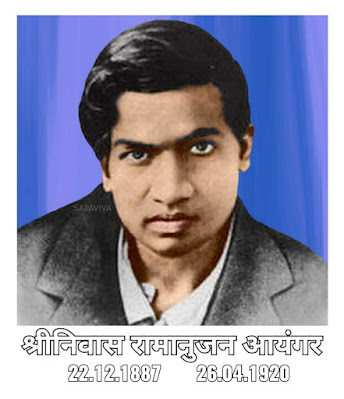
Remembering Srinivasa Ramanujan: A Mathematical Genius

Image
As we remember Srinivasa Ramanujan on his death anniversary, let us honor his legacy by continuing to explore the mysteries and beauty of mathematics. Let us be inspired by his dedication, perseverance, and love for mathematics, and strive to make our own contributions to the field. Ramanujan's work has inspired and influenced generations of mathematicians around the world. His ability to see patterns and connections in mathematics that others could not has led to significant advances in number theory, mathematical analysis, and other areas of mathematics. His life and work continue to be celebrated and honored by mathematicians and mathematic lovers around the world.

Transformation of Teaching-Learning Process through Digital Platforms

Image
Completed one-week FDP on the topic Transformation of Teaching-Learning Process through Digital Platforms from 09-04-2023 to 15-04-2023 organized by Udaan Educational Services.  #lifelonglearing #FDP #professionaldevelopment

Curriculum for the session 2023-24 released by CBSE (along with Sample Papers)

  The curriculum for the session 2023-24 is released by CBSE (along with Sample Papers) https://cbseacademic.nic.in/curriculum_2024.html Sample Question Papers – Secondary – https://cbseacademic.nic.in/SQP_CLASSX_2023-24.html Sample Question Papers – Senior Secondary – https://cbseacademic.nic.in/SQP_CLASSXII_2023-24.html

Virtual Labs for self paced & classroom teaching learning

Image
 Received certificate of appreciation for participating in the five hours online orientation program on Virtual Labs for self-paced & classroom teaching learning organized by the Central Institute of Educational Technology, NCERT

VI-XII NEW NCERT TEXTBOOKS FOR 2023-24 SESSION (BASED ON RATIONALIZED CURRICULUM)

VI-XII NEW NCERT TEXTBOOKS FOR 2023-24 SESSION (BASED ON RATIONALIZED CURRICULUM) Available at the following link .  

Some Facts About Pi

 Some Facts About Pi ๐Ÿ“ŒPi (ฯ€) is a mathematical constant that represents the ratio of the circumference of a circle to its diameter. ๐Ÿ“ŒPi is an irrational number, which means it cannot be expressed as a finite decimal or fraction. Its decimal representation goes on infinitely without repeating. ๐Ÿ“ŒThe value of pi is approximately 3.14159265359, but it can be calculated to an infinite number of decimal places using various mathematical methods. ๐Ÿ“ŒThe ancient Egyptians and Babylonians knew about the concept of pi, but it was the Greek mathematician Archimedes who first calculated an accurate approximation of pi around 250 BC. ๐Ÿ“ŒThe symbol for pi (ฯ€) was first used by the Welsh mathematician William Jones in 1706, but it was popularized by the Swiss mathematician Leonhard Euler in the 1700s. ๐Ÿ“ŒPi appears in many areas of mathematics and science, including geometry, trigonometry, calculus, and physics. It also plays a crucial role in the design of many everyday objects, such as wheels, ...